πŸ“ SCHOOL LOCATION
1063 4 Mile Rd NW, Suite 200
Grand Rapids, MI 49544

About Our Program

An accelerated, full-time, 4.5-week Phlebotomy Technician program combining four weeks of structured online coursework and independent skills practice with required in-person hands-on training and competency evaluations.


Our Phlebotomy Technician course provides students with the essential knowledge and hands-on skills required to safely and effectively collect blood specimens for laboratory testing. Designed for individuals pursuing a career in healthcare, this course covers venipuncture techniques, patient interaction, infection control, specimen handling, and safety procedures in accordance with industry standards.


Students will gain practical experience through supervised lab exercises and clinical skills checkoffs, ensuring confidence in performing blood draws in various healthcare settings. The curriculum also includes anatomy and physiology of the circulatory system, medical terminology, ethical considerations, and legal responsibilities.


Upon successful completion of the course, students will be prepared to take a national certification exam and pursue employment opportunities in hospitals, clinics, diagnostic laboratories, and other medical facilities.


Program is 4.5 weeks. 

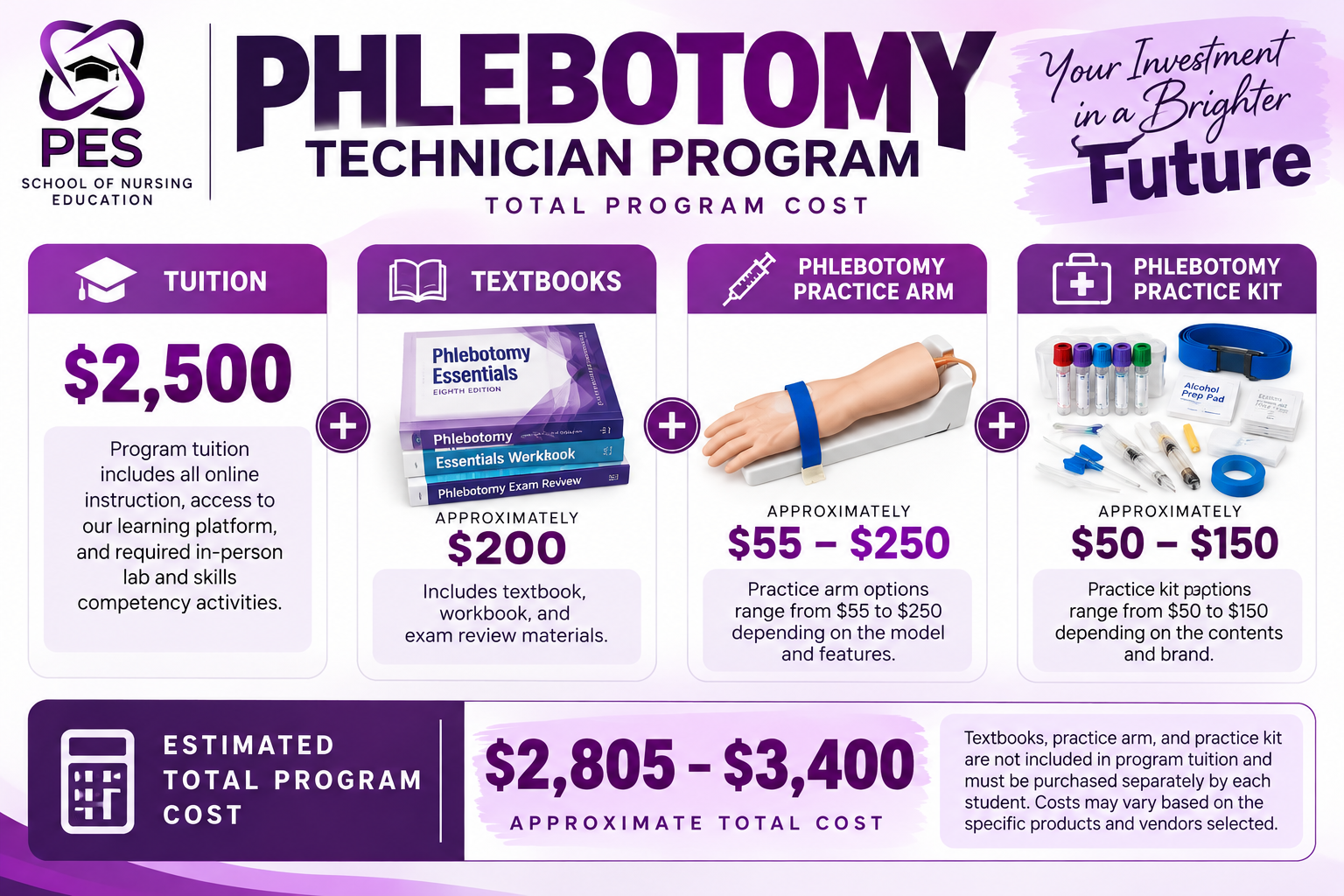
Tuition is just $2500     (Required books and supplies are additional cost.)

PES School of Nursing Education

Your 4.5-Week Phlebotomy Training Journey

Our accelerated, full-time hybrid program combines four weeks of structured online instruction with required in-person laboratory training and skills competency evaluations.

4.5 Weeks Total Program Duration
160 Hours Online Instructional Curriculum
4 Units One Unit Per Week
Week 1 40 Hours

Unit 1: The Healthcare Setting

  • Chapter 1: Phlebotomy: Past and Present and the Healthcare Setting
  • Chapter 2: Quality Assurance and Legal Issues in Healthcare
  • Chapter 3: Infection Control, Safety, First Aid, and Personal Wellness
Online Learning and Assigned Skills Practice
Week 2 40 Hours

Unit 2: Overview of the Human Body

  • Chapter 4: Medical Terminology
  • Chapter 5: Human Anatomy and Physiology Review
  • Chapter 6: The Circulatory System
Online Learning and Assigned Skills Practice
Week 3 40 Hours

Unit 3: Blood Collection Procedures

  • Chapter 7: Blood Collection Equipment, Additives, and Order of Draw
  • Chapter 8: Venipuncture Procedures
  • Chapter 9: Preexamination/Preanalytical Considerations
  • Chapter 10: Capillary Puncture Equipment, Principles, and Procedures
Online Learning and Assigned Skills Practice
Week 4 40 Hours

Unit 4: Special Procedures

  • Chapter 11: Special Collections and Point-of-Care Blood Tests
  • Chapter 12: Laboratory Informatics and Specimen Handling and Processing
  • Chapter 13: Urine and Other Nonblood Specimens and Tests
  • Chapter 14: Arterial Puncture Procedures
Online Learning and Assigned Skills Practice
Final In Person

In-Person Lab and Skills Competency

After completing the four online instructional units, students attend required hands-on laboratory training and skills evaluations at PES School of Nursing Education.

  • Practice essential phlebotomy techniques
  • Apply infection prevention and patient safety procedures
  • Demonstrate proper collection equipment preparation
  • Practice venipuncture and capillary collection skills
  • Complete required skills competency evaluations
Required In-Person Attendance

Important: Full-Time Program Expectations

The Phlebotomy Technician Program is an accelerated, full-time training program consisting of 180 total instructional and skills hours completed over approximately 4.5 weeks.

Students complete 40 hours of structured online instructional activities during each of the first four weeks. An additional 20 hours are dedicated to laboratory practice and skills competency activities, including assigned independent practice at home and required in-person training and evaluation.

Online learning does not mean self-paced or part-time training. Students must complete weekly coursework, assignments, examinations, and designated skills practice while meeting all published program deadlines and competency requirements.

Required At-Home Phlebotomy Skills Practice

Our Phlebotomy Technician Program is a full-time, 4.5-week hybrid program that includes 160 hours of online instruction and 20 hours of laboratory practice and skills competency activities.

Students are required to purchase their own phlebotomy practice arm and phlebotomy practice kit. These materials are essential components of the program and allow students to practice assigned skills at home throughout the online portion of their training.

Students are expected to practice regularly using their required equipment, complete assigned skills activities, and arrive at their scheduled in-person laboratory session prepared to demonstrate their knowledge and techniques.

The final program component includes required instructor-supervised laboratory training and skills competency evaluations.

Important: The practice arm and phlebotomy practice kit are mandatory purchases and are not included in program tuition. Purchase links are provided in the required materials section of this webpage.

Program Start dates

October 1, 2026

November 1, 2026

December 1, 2026

January 1, 2027

February 1, 2027


Tuition and Total Program Cost

How to Pay for Your Phlebotomy Training

Investing in your healthcare career should be straightforward. PES School of Nursing Education offers two convenient tuition payment options.

Option 1: Pay in Full

$2,500

One tuition payment. No financing charges.

  • Pay your full tuition before classes begin.
  • No interest or financing charges.
  • No monthly tuition payments.
  • Textbooks and required practice supplies are purchased separately.

Option 2: Tuition Financing

$500 Down

Finance the remaining $2,000 in tuition through our approved financing partner, TFC.

Plan APR Monthly Payment
4 Months 16% Approx. $516.78
6 Months 18% Approx. $351.05
  • A $500 tuition down payment is required before classes begin.
  • Students must select the $500 down payment option when completing their TFC application.
  • Financing agreements must reflect a remaining tuition balance of $2,000.
  • Tuition financing must be finalized before access to online coursework is granted.

Important: Books and Supplies Are Not Financed

Tuition financing is available for tuition only. PES School of Nursing Education does not offer financing for textbooks, uniforms, phlebotomy practice arms, phlebotomy practice kits, or other required program supplies.

Students are responsible for purchasing all required books and equipment separately and having them available when needed for their coursework and skills practice.

Estimated additional costs: Textbooks approximately $200; phlebotomy practice arm $55–$250; and phlebotomy practice kit $50–$150. Actual prices vary by vendor.

Financing payment examples assume a $500 down payment, $2,000 financed, monthly amortization at the stated APR, and payments beginning one month after financing. Actual payment schedules and financing terms are established by TFC. Certification examination fees are separate from tuition and required supplies.

Links to purchase required materials

Required Textbooks

ISBN: 9781284292688


Phlebotomy Essentials- 8th Edition

Ruth McCall


Student Workbook for Phlebotomy Essentials- 8th Edition


Phlebotomy Exam Review- 8th Edition

Ruth McCall


$199.95 for entire bundle


Bundle available through Jones and Bartlett Learning: 


Phlebotomy Practice Arm

Practice phlebotomy arm.

Must be able to push fake blood through and use to start blood draws. 


There are many available for purchase through Amazon, eBay, and other vendors. If you are in doubt, please check with staff. 


Purchase cost averages from $55-$125 depending on model. 

Phlebotomy Blood Draw Practice Kit

Available for purchase via Amazon. 

Laptop computer or tablet is required for online classroom access for all of our students. You may not use a phone to access our LMS.

Frequently Asked Questions

SUBMIT YOUR APPLICATION HERE
What is a phlebotomy technician?

A Phlebotomy Technician, also called a Phlebotomist, is a healthcare professional trained to draw blood from patients for medical testing, transfusions, donations, or research. Their role is crucial in diagnostic and clinical settings

What do phlebotomists do?

Phlebotomists are responsible for:

Drawing blood via venipuncture (from a vein), fingersticks, or heelsticks (in infants), Verifying patient identity and labeling specimens correctly, Preparing specimens for transport to labs, Maintaining patient safety and comfort during blood draw, Following strict infection control and safety procedure, Managing supply inventory and maintaining equipmen, Assisting with data entry and record-keeping related to specimen collection

They often work directly with patients of all ages and must have good interpersonal and communication skills, as well as a steady hand and attention to detail.

Where can they work?

Phlebotomy Technicians can work in various healthcare settings, including:

Hospitals

Clinical laboratories

Doctor’s offices

Blood donation centers (e.g., Red Cross)

Public health departments

Nursing homes or long-term care facilities

Mobile blood draw units or home health services

How do you become a phlebotomy technician?

Most employers require:

A high school diploma or equivalent

Completion of a phlebotomy training program (offered by community colleges, vocational schools, and some hospitals)

Certification (often preferred or required), such as:

Certified Phlebotomy Technician (CPT) – NHA

Phlebotomy Technician (PBT) – ASCP

Registered Phlebotomy Technician (RPT) – AMT

Certification typically requires passing an exam and proof of training or work experience.

How Much Do Phlebotomy Technicians Make in Michigan?

As of recent data (2024 estimates):

Average hourly wage in Michigan: ~$18.00 – $22.00

Annual salary range: $37,000 – $46,000 depending on experience, location, and employer

Phlebotomists in major metro areas like Detroit, Grand Rapids, or Ann Arbor may earn more, especially in hospital systems or with additional credentials.


Some may also work as independent contractors and can make upwards of $30-35 per hour.

.

How do I get started?

We will be offering classes starting every month (July 1!) and you can sign up to get started almost right away!