
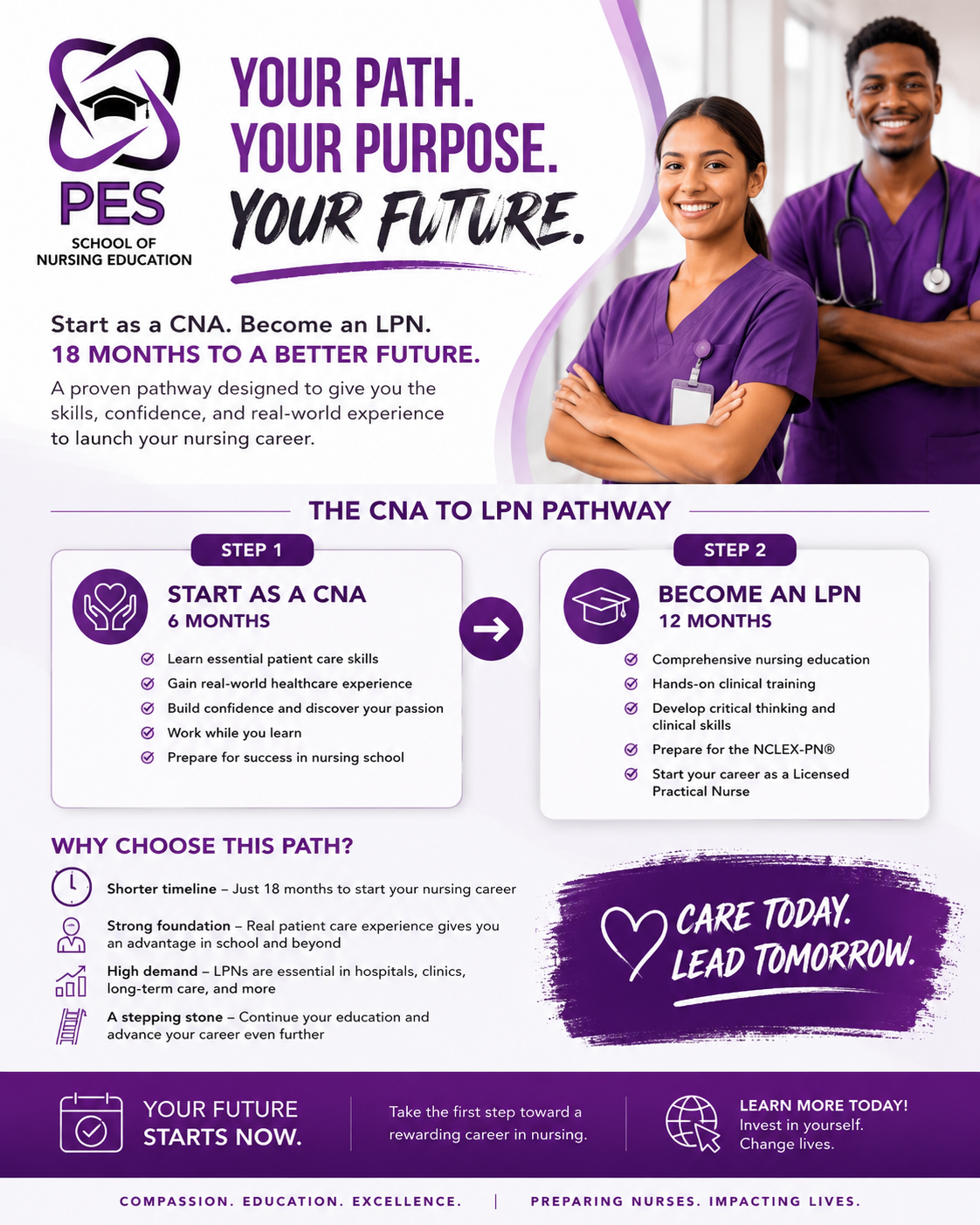
CNA To LPN in 18 Months
The suggested pathway for starting your career in healthcare!
18 Months to Becoming an LPN:
A Comprehensive Guide to Starting Your Nursing Career
If you are considering a career in nursing but are unsure where to begin, becoming a Licensed Practical Nurse (LPN) can be one of the most rewarding and practical pathways into healthcare. For many aspiring nurses, the journey can realistically begin with becoming a Certified Nursing Assistant (CNA), gaining valuable hands-on experience, and then transitioning into an LPN program.
This step-by-step approach not only builds confidence and clinical skills, but also helps students truly understand patient care before advancing into nursing responsibilities.
Before entering many practical nursing pathways, students benefit greatly from working as a CNA. In fact, many schools (including ours) require that applicants have direct patient care experience.
As a CNA, you learn the foundation of healthcare:
• Infection control
• Patient safety
• Communication and bedside manner
• Taking vital signs
• Activities of daily living
• Documentation basics
• Recognizing changes in patient conditions
• Teamwork within healthcare environments
Working as a CNA also provides invaluable real-world exposure to long-term care, rehabilitation, hospitals, hospice, and assisted living settings. Students quickly learn whether nursing is truly the right fit for them while earning income and gaining experience.
Many future nurses discover that these first six months shape the type of nurse they eventually become.
Once foundational experience has been established, students can move into practical nursing education. A strong LPN curriculum builds upon CNA skills while introducing more advanced nursing concepts and clinical decision-making.
During an LPN program, students typically study:
• Anatomy and physiology
• Pharmacology
• Medical-surgical nursing
• Maternal and pediatric nursing
• Mental health nursing
• Leadership and professionalism
• IV therapy and medication administration
• Clinical judgment and patient assessment
• Care planning and documentation
Clinical experiences allow students to apply these skills in real healthcare settings under instructor supervision.
This stage is where students begin transitioning from task-based caregiving into the role of a licensed nurse capable of making clinical observations, administering medications, communicating with providers, and coordinating patient care.
One of the greatest advantages of beginning as a CNA is confidence.
Students who enter nursing school with healthcare experience often:
• Adapt more quickly to clinical environments
• Have stronger bedside communication skills
• Understand patient workflows and expectations
• Feel more comfortable with direct patient care
• Develop stronger time management skills
Healthcare experience also helps students connect classroom concepts to real-life situations, making the learning process more meaningful and easier to understand.
The healthcare industry continues to face significant staffing shortages nationwide. Practical nurses remain essential members of the healthcare team in:
• Skilled nursing facilities
• Rehabilitation centers
• Hospitals
• Home health
• Hospice
• Assisted living communities
• Physician offices
• Specialty clinics
For many students, becoming an LPN is not the final destination, but rather the beginning of a long-term nursing career that may eventually include RN, BSN, MSN, or even doctoral-level education.

School of Nursing Education